
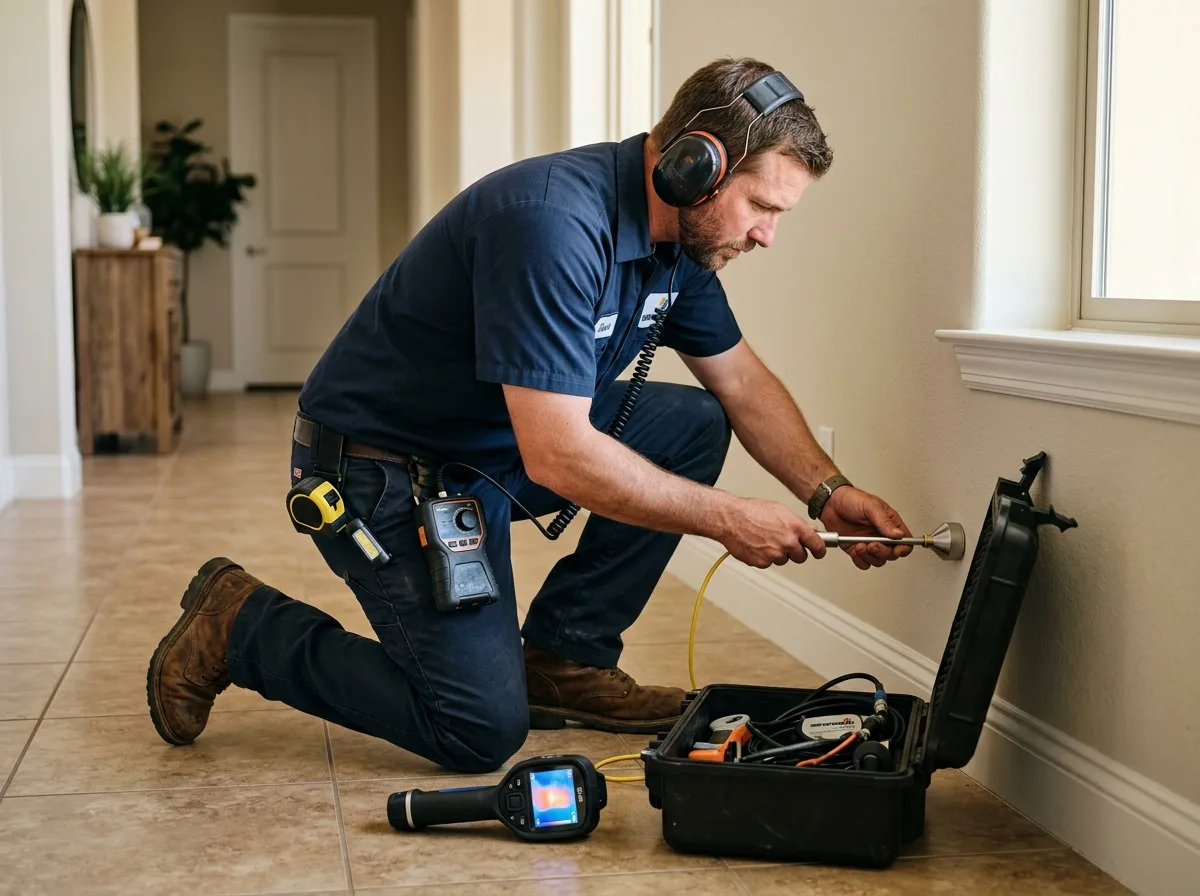
Non-invasive leak detection Hanford CA pinpoints concealed plumbing leaks buried under concrete slab foundations, hidden inside structural wall cavities, or leaking along underground yard water service lines. Utilizing digital acoustic sensors, nitrogen pressure testing, and infrared thermal imaging, our technicians identify the precise failure point without exploratory wall destruction. Call (559) 340-2572 for immediate diagnostic scheduling and upfront written estimates.
Signs You Have a Concealed Plumbing Leak
Not all plumbing leaks manifest as dramatic, spraying fountains under kitchen sinks. In fact, the most destructive leaks in Kings County are slow, pressurized pinhole ruptures buried beneath concrete foundations or enclosed inside insulated exterior walls. Left undetected for weeks or months, a hidden leak erodes foundational subsoil, rots load-bearing structural studs, breeds toxic black mold, and inflates municipal utility costs by hundreds of dollars.
If you are experiencing any of these unexplained household anomalies, reach out to an experienced water leak detector near me immediately:
Unexplained Spikes in Your City Water Bill
If your monthly City of Hanford utility bill increases significantly without changes in household occupancy, landscape watering, or seasonal pool filling, a pressurized line is constantly bleeding water.
Hot or Warm Spots on Tile, Vinyl, or Carpet Flooring
A hot domestic water line leaking beneath a concrete slab foundation transfers thermal energy directly upward into flooring surfaces, creating localized warm zones detectable in bare feet.
Damp Drywall, Baseboard Warping, or Musty Smells
Water migrating horizontally along sill plates causes drywall to soften, paint to blister, baseboards to cup, and creates persistent mildew odors in hallways and closets.
Audible Running Water Hissing Behind Walls
Hearing a faint, continuous rushing or hissing sound when all taps, showers, toilets, and irrigation valves are fully shut off indicates water escaping through a cracked copper fitting under pressure.
Other serious signs include cracked foundation perimeter footings, persistent low water pressure throughout the home, and pooling groundwater along outdoor exterior walls during dry summer weather.
Non-Invasive Acoustic & Thermal Locating
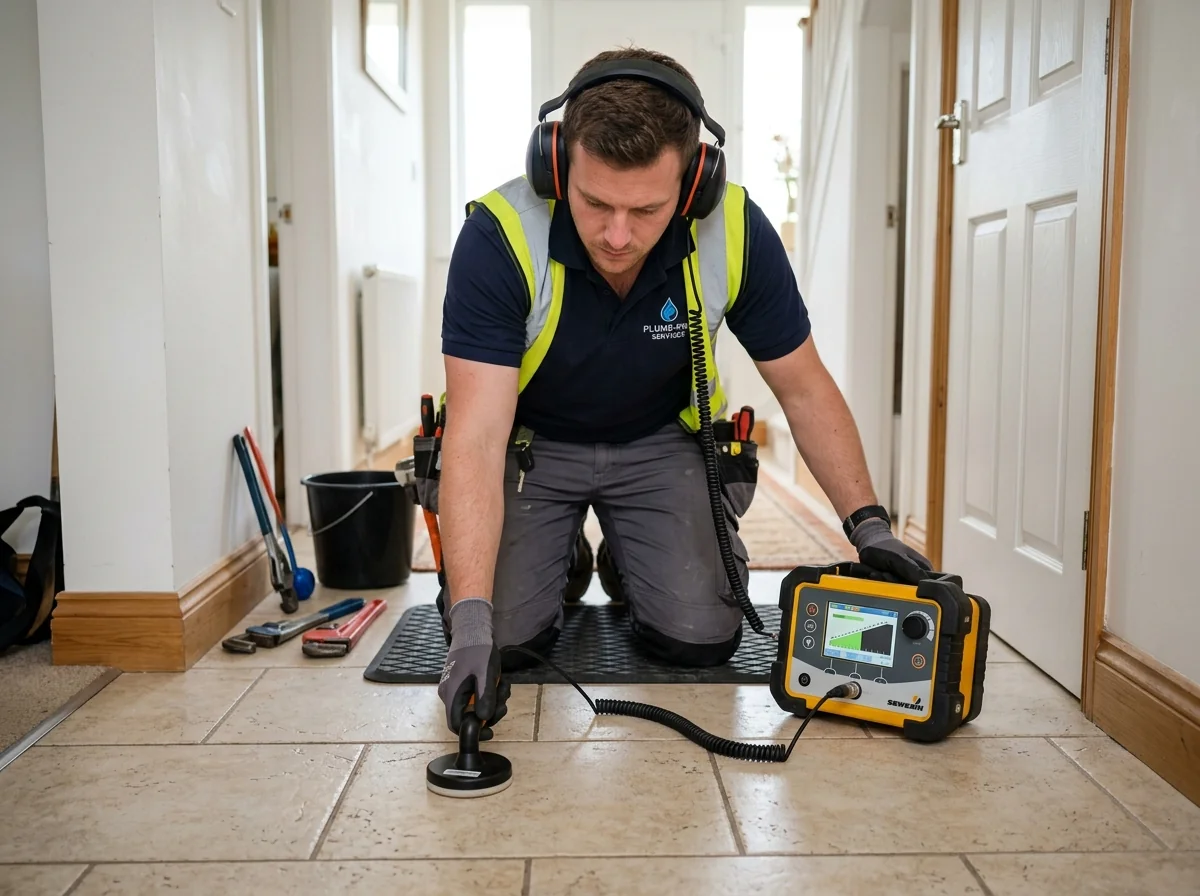
- High-frequency ground microphones isolating sub-slab pressurized spray
- FLIR thermal imaging identifying hot water supply line migration
- Zero unnecessary concrete demolition before exact point confirmation
 Field Diagnostic Standard
Our Specialized Leak Detection & Repair Services in Hanford
We deploy modern electronic diagnostic technologies that eliminate blind exploratory demolition. Once located, our licensed technicians provide long-lasting repairs tailored to your home’s architecture:
- Non-Invasive Foundation Diagnostics: We deploy acoustic listening discs and ground microphones for precision slab leak repair in Hanford, identifying pinhole failures beneath concrete floors with pinpoint accuracy.
- Underground Yard Supply Diagnostics: From the water meter box to the building shutoff, we conduct electronic line tracing and trenchless water line repair to stop outdoor leaks without destroying lawns.
- High-Pressure Pipe Ruptures: When freeze cycles, soil movement, or water hammer cause supply lines to fracture, we quickly isolate and fix a burst pipe with durable copper or PEX-A transitions.
- Whole-House Pipe Replacement: If repeated pinhole leaks plague aging copper or galvanized piping, we consult on options to completely repipe your home with flexible, corrosion-proof PEX.
- High-Urgency Water Isolation: When water is actively pouring through ceilings or flooding living areas after hours, call an emergency plumber immediately for rapid dispatch and isolation.
- Mineral Scale & Pipe Protection: Hanford's aggressive groundwater accelerates pipe corrosion; protect your plumbing by investing in whole-house water treatment installs tailored to local well chemistry.
Why Plumbing Leaks Are Prevalent in Hanford & Kings County
Plumbing systems in Hanford exist in a harsh subterranean and climatic environment. The region sits in the Tulare Lake Basin, characterized by deep alluvial clay soils that expand significantly during wet winter periods and shrink dramatically during hot, arid summer months. This cyclical soil movement places severe mechanical shear stress on rigid copper water lines embedded directly within concrete slab foundations.
Furthermore, homes constructed throughout Kings County during the 1970s, 1980s, and 1990s routinely utilized Type M (thin-wall) copper tubing laid directly over coarse rock bedding prior to concrete pours without protective polyethylene sleeving. Over years of thermal cycling—where hot water lines expand and contract against rough concrete aggregates and sharp sand—the copper wall wears thin from the outside in.
Concurrently, Hanford's municipal groundwater contributes to internal erosion. The city’s 13 deep municipal wells supply water with an average hardness of elevated mineral hardness and elevated total dissolved solids (TDS). High water velocity passing through undersized fittings causes localized cavitation and microscopic eddy currents. These hydraulic vortices scrub away the protective internal copper patina, causing pinhole leaks from the inside out. When combined with winter freezing temperatures that dip below 32°F an average of 26 nights per year, uninsulated attic piping and outdoor hose bibs experience severe structural failure.
How We Detect and Map Hidden Leaks Step by Step
Accurate leak detection is an advanced science combining acoustic physics, thermal dynamics, and pneumatic pressure testing. We follow an exacting systematic protocol:
Meter Isolation & Pressure Decay Test
We isolate fixtures and attach calibrated pressure gauges to test whether the hot, cold, or irrigation system is losing hydrostatic pressure.
Infrared Thermal Imaging Scan
Using FLIR high-resolution thermal cameras, we scan floorboards, drywall, and ceilings to trace subsurface thermal anomalies and hot water plumes.
High-Frequency Acoustic Sonar Listening
We deploy electronic ground microphones and frequency-filtered amplifiers that isolate the distinct high-pitch hiss of escaping pressurized water.
Pinpoint Surface Marking & Repair Quote
We mark the exact failure coordinates on the floor or wall within inches and provide clear, upfront repair options before any physical opening is made.
How Much Does Leak Detection and Repair Cost in Hanford?
Leak detection and repair pricing in Hanford is structured in two distinct phases: the electronic diagnostic phase to locate the leak, followed by the physical plumbing repair.
A standard non-invasive electronic leak detection service call generally costs between $150 and $450, depending on the complexity of the home's layout, multi-story construction, and whether the leak is interior or located along an exterior underground yard service line. Once the leak is mapped, physical repair options range from $350 to $2,500+ based on whether direct slab breakout, overhead PEX rerouting, or yard trenching is chosen.
| Leak Diagnostic & Repair Scope | Estimated Cost Range | What Is Included |
|---|---|---|
| Residential Electronic Leak Detection Service | $150 – $450 | Acoustic listening, thermal scan, pressure decay test, pinpoint marking |
| Exposed Drywall Pipe Pinhole Repair | $250 – $550 | Drywall access cut, copper/PEX coupling transition, pressure re-test |
| Direct Slab Breakout & Foundation Spot Repair | $850 – $2,200 | Jackhammer concrete penetration, subsoil excavation, brazed copper repair, backfill |
| Overhead PEX Single-Line Slab Bypass Reroute | $1,200 – $2,800 | Abandoning leaking under-slab line, running continuous PEX through attic/walls |
| Main Yard Water Line Spot Repair | $450 – $1,100 | Hand excavation up to 4 ft deep, Schedule 40 PVC or copper repair, gravel bedding |
| Complete Yard Water Line Replacement (Trenchless) | $2,500 – $5,500 | Pulling seamless continuous 1-inch PEX-a from street meter to house shutoff |
Direct slab breakout involves noisy jackhammering, concrete dust, and breaking through finished tile or hardwood flooring. For this reason, our technicians frequently recommend modern overhead PEX bypass reroutes, which route a new flexible line through attics and interior drywall with minimal cosmetic disruption and permanent peace of mind.
How to Check for a Hidden Leak at Your Water Meter
You can easily verify whether an active leak exists on your Kings County property using your municipal water meter:
- Turn Off All Household Water Usage: Ensure all indoor faucets, showers, laundry machines, dishwashers, and outdoor hose bibs are tightly closed. Make certain toilets have finished filling and no automated landscape irrigation timers are active.
- Locate Your City of Hanford Meter Box: The meter is housed in an in-ground concrete box near your front sidewalk or street curb. Carefully pry off the metal or composite lid with a screwdriver or meter key.
- Examine the Dial Face and Low-Flow Indicator: On modern digital meters, look for a small red triangle, rotating star gear, or flashing faucet icon. If this low-flow dial is spinning—even slowly—water is flowing through the meter.
- Perform a 30-Minute Static Test: If the dial appears stationary, record the exact numeric reading on the dial down to the last decimal. Leave all water off for 30 minutes, then re-read the meter. If the numbers have increased, an active subterranean or in-wall leak is confirmed.
- Isolate Interior vs. Exterior Yard Leaks: Locate your house main shutoff valve (usually on the front wall exterior near the hose bib) and turn it off. Check the street meter again. If the meter stops spinning, the leak is located inside your home or beneath the slab. If the meter continues to advance with the house shutoff closed, the leak is located underground in your yard service line between the meter and the house.
Representative Leak Detection Scenarios
Here are illustrative leak detection scenarios showing how hidden water leaks across Hanford are pinpointed and resolved:
Concrete Foundation Slab Leak
Scenario: A homeowner notices hot floor tiles or hears water running when all faucets are closed, indicating a sub-slab copper pinhole leak.
Diagnostic & Approach: An acoustic leak detection specialist uses ground microphones and thermal cameras to isolate the leak location under the concrete. A contractor may recommend an overhead attic PEX-A reroute to bypass the failing line without jackhammering floors.
Underground Yard Service Line Leak
Scenario: Damp soil or a spinning water meter leak indicator indicates a pressurized water leak between the municipal meter and the home shutoff.
Diagnostic & Approach: Technicians use electromagnetic pipe locators to trace the buried supply line, excavate the damaged section safely, and install heavy-duty compression fittings or pull a new continuous service line.
Enclosed Wall Cavity Seepage
Scenario: Paint bubbling or baseboard moisture behind a second-story bathroom suggests a slow pipe or fitting leak inside framing.
Diagnostic & Approach: Moisture meters and thermal imaging identify the exact dampness boundary, allowing small, surgical access cuts to repair the leaking fitting with minimal drywall disruption.
Safety, Structural Integrity and Mold Prevention
Hidden water leaks represent serious structural and biological threats. In the warm Central Valley climate, toxic mold spores (including Stachybotrys chartarum and Aspergillus) can germinate on damp drywall and cellulose insulation within 24 to 48 hours of initial moisture exposure.
Furthermore, water escaping under high pressure beneath a concrete foundation washes away compacted subsoil sand and clay, creating voids that lead to foundation slab settlement, cracked drywall, and sticking interior doors. If an active leak is located near your electrical service entrance, subpanel, or baseboard heaters, shut off the main water valve immediately. All structural pipe repairs completed by our team comply strictly with the California Plumbing Code (CPC), ensuring correct pipe anchoring, dielectric separation between dissimilar metals, and hydrostatic pressure testing.
Where We Provide Leak Detection in Kings County
Our Plumber in Hanford diagnostic vans provide prompt leak detection and repair coverage throughout Kings County:
- Hanford Central & Historic Districts: Complete coverage for older slab and raised-foundation homes across downtown residential corridors and Lacey Boulevard.
- Quail Run & Stone Crest Developments: Precision non-invasive acoustic diagnostics from a qualified Quail Run and Stone Crest plumber.
- North & West Hanford: Fast response times from technicians providing plumbing near Hidden Valley Park and Centennial Park neighborhoods.
- Lemoore: Expert electronic line testing and slab repairs from technicians delivering plumbing help in Lemoore.
- Corcoran: Experienced service from a dependable plumber in Corcoran for residential, commercial, and agricultural properties.
 Code Compliance Verified
Hydrostatic Line Isolation & Pressure Testing
- Precision liquid-filled gauge monitoring across municipal supply line
- Sectional valve isolation separating domestic fixtures from irrigation
- Permanent overhead copper/PEX reroute options bypassing cracked slab pipes
Frequently Asked Questions
Direct, helpful answers regarding leak detection and repair in Hanford, CA.
How do I know if I have a hidden leak?
How much does leak detection cost in Hanford?
Will you have to tear up my floor?
Does homeowners insurance cover leak repairs?
Need Fast, Reliable Plumbing Help in Hanford?
Get direct phone guidance, upfront written estimates before any work begins, and prompt dispatch from experienced technicians across Hanford, Lemoore, Corcoran, and surrounding communities.